Is your digital strategy subjugated to Big Tech feudals - and can you fight back?
My take on Yanis Varoufakis' "Techno Feudalism" - and what it reveals about cloud power, platform risk, and your company's urgent need to build (and defend) its own digital kingdom

This Week’s Spark
The opening of Techno Feudalism reads like a communist manifesto. You know - “death to capitalists, power to the workers.” Unsurprising from a leftist, Marxist ex–Finance Minister of Greece who negotiated one of its many bailouts a decade ago. But not exactly the business read I was looking forward to.
However, if you’re patient enough to look past the dense jargon, Greek mythology analogies, and occasional dystopian tone - there’s a lot to learn. And if you’re not? Don’t worry - I’ve distilled the key ideas here.
TLDR – What’s This Book About?
In Techno Feudalism, Yanis Varoufakis argues that traditional capitalism has been overtaken by a new regime: techno feudalism. A digital-era system in which FAANGs behave like feudal lords - controlling “cloud capital,” extracting data “rents” from users (aka “cloud serfs”), and shaping preferences via algorithms. The result? Market choice and profit are replaced by centralised rent extraction.
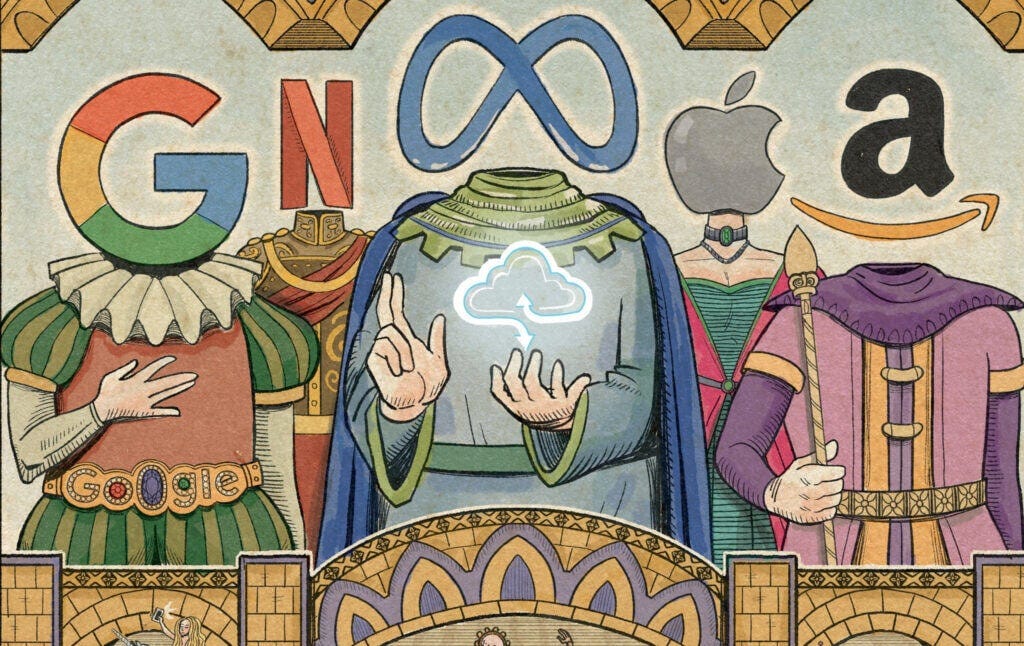
Source: Current Affairs
Varoufakis focuses on the (bleak) perspective of the “cloud serf” - end user who provides free services like content creation in exchange for access to these platforms.
But here’s the shift: I urge you to examine these ideas not as an individual Big Tech critic, but as a business leader. Techno feudalism is (cliché incoming) both a threat and an opportunity. It’s up to you and your business how you respond to both.
Sharp Takeaways – Questions Every Leader Should Ask
Are you creating value - or paying rent to the cloud?
Is your USP powered by you, or outsourced to platforms? Would your business still function if one of those platforms disappeared?Your customers aren’t just buying - they’re generating valuable data. But who owns the insight?
Every interaction enriches a dataset. But are you benefiting from it - or are the platforms? Could that data become a product in its own right?Are digital tools becoming dependencies?
What started as enablers (CRM, e-commerce, ads) may now be crutches. Are you future-proof - or vulnerable to a change in someone else’s API or algorithm?Are Big Tech platforms your partners - or just landlords?
Once, power came from owning land. Then factories. Now? Platforms own the terrain and the means of production. Would your “partner” switch you off if it suited them?Is it time to rethink your digital sovereignty?
If your value chain increasingly flows through Big Tech, then your autonomy, pricing power, and brand narrative are at risk. You may not become a digital empire - but building a fierce fief with a USP castle and deep business moats is within your power.
Shelf to Boardroom – How I’d Use This Book
Techno Feudalism isn’t a “quick win” playbook. It’s intellectual scaffolding. A way to evaluate your business model, infrastructure choices, and platform dependencies through the lens of power and ownership.
You don’t need to agree with every thesis Varoufakis presents - but the reality of platform reliance and eroding control is indisputable.
If I were advising a board or senior leadership team on digital transformation, I’d use this book to frame the conversation around digital sovereignty:
Is this initiative increasing or reducing our platform dependence?
If increasing - are there alternatives?
What mitigation is in place? Can we avoid lock-in?
Is our relationship with the platform owner mutually beneficial - or extractive?
What moats can we build or strengthen to protect our independence?
What investments can reinforce our own digital “feud”?
Even seemingly harmless platform integrations deserve scrutiny. Connecting to “yet another API” may bring short-term value - but are we slowly giving away something bigger?
Digital infrastructure is no longer simply an enabler - it’s the terrain of power itself. That should change how we think about digital transformation - or even what it means.
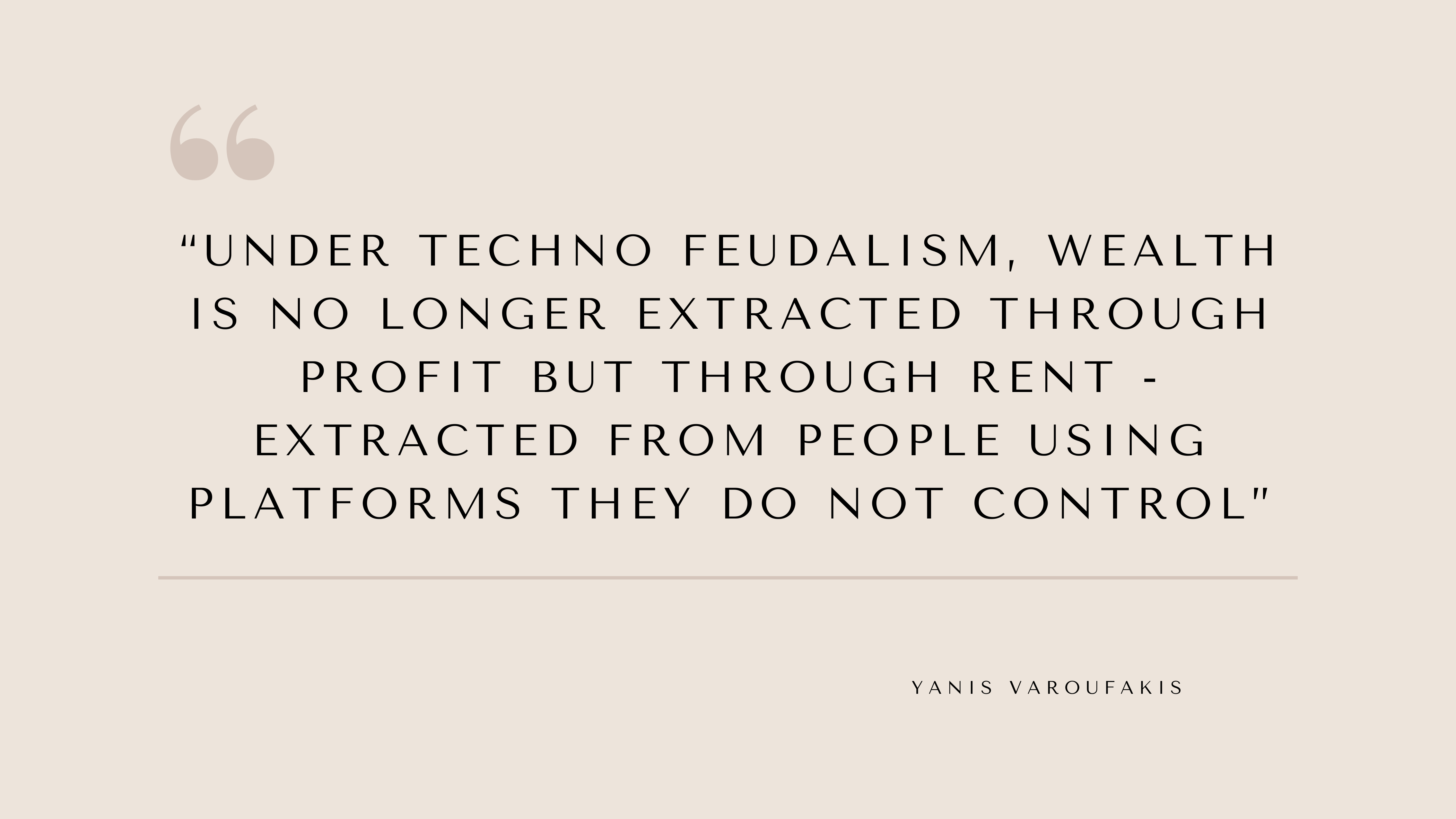
Quote of the Week
📍 Where I’m Reading This

I read this book at one of my favourite Gdansk spots for working and thinking - Sztuka Wyboru. It’s a bookstore, cafe, and co-working space with a very zen outdoor area.
Up Next on the Shelf
Next week: a not-so-obvious business read - Genghis Khan and the Making of the Modern World by Jack Weatherford. It’s astonishing how many lessons relevant in 2025 emerge from the world’s largest empire built some 800 years ago.
Got a better pick? Reply or find me on LinkedIn.
If you received this newsletter by email out of the blue…
Then congrats - you’ve survived more than one of my newsletter experiments.
Chances are, you signed up during peak Covid, sometime in 2020, when we were all stuck indoors, baking banana bread and pretending to like Zoom. That version quietly disappeared once lockdowns lifted and I rediscovered the outdoors (and sunlight).
This is the reboot - sharper, better caffeinated, and hopefully more useful. I’d love for you to stick around. But if your inbox is already overflowing - no hard feelings. Unsubscribe buttons exist for a reason.